
I pulled the “basic policy on human-capital strategy” text and the “year-on-year change in average salary” (call it a rough pay-raise rate) out of the FY March 2026 annual securities reports, and ran some analysis on them.
Both are brand-new disclosure items, mandated only from this year.
Pay raises overall (median 3.2%)
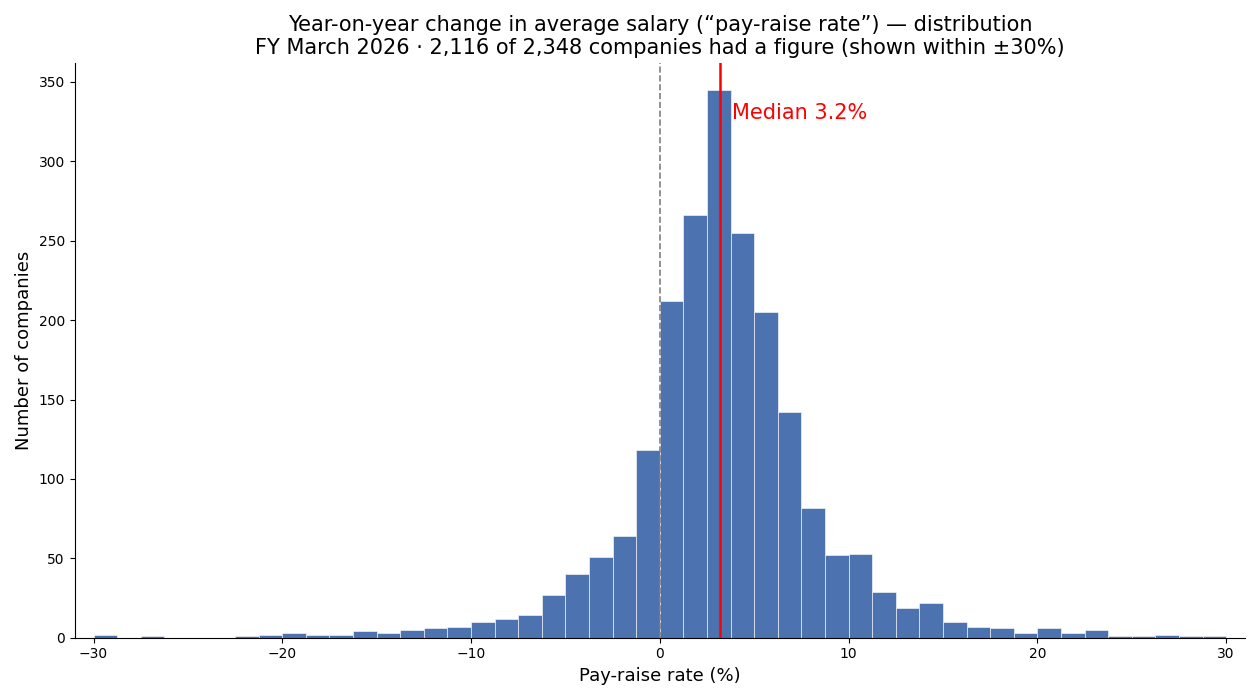
Of all 2,348 companies, 2,116 reported a pay-raise rate (year-on-year change in average salary) as an actual number. The rest didn’t disclose one, or it couldn’t be extracted.
Line those 2,116 up, and the median is 3.2%. That’s roughly in line with the general mood around wage hikes.
But look closer, and about one in five (roughly 18%) is negative.
In other words, average pay actually fell from the year before. With prices climbing the way they are, the world isn’t so kind.
A 3x gap by industry
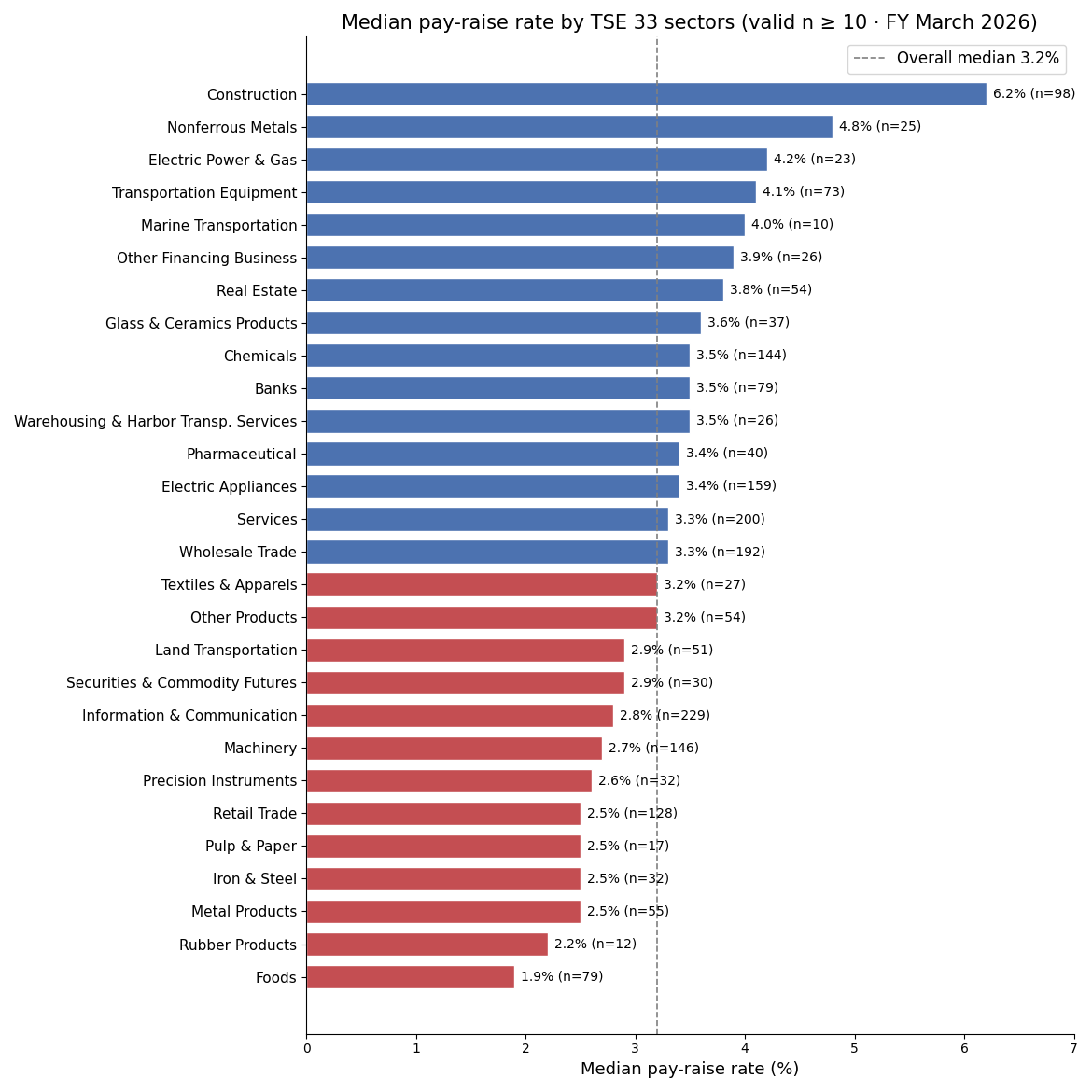
What’s interesting is the spread across industries.
The highest is construction at 6.2%; the lowest is food products at 1.9%. That’s a gap of more than three times.
Construction can’t hire without raising pay in a tight labor market; food products sell daily necessities and struggle to pass costs on to prices. Put it that way, and it starts to make sense.
There’s also a gap by company size: the bigger players (Prime-listed, large market cap) tended to raise pay more generously. Industry and size come from matching companies to the TSE listing table via their securities code.
Each figure is the median among the companies for which a pay-raise rate could be obtained.
So what is everyone actually writing?
Here’s the main event. Feed the human-capital-strategy text to AI (a technique called topic modeling), and it sorts everything into eight themes on its own.
Here’s the “map,” with related themes placed closer together.
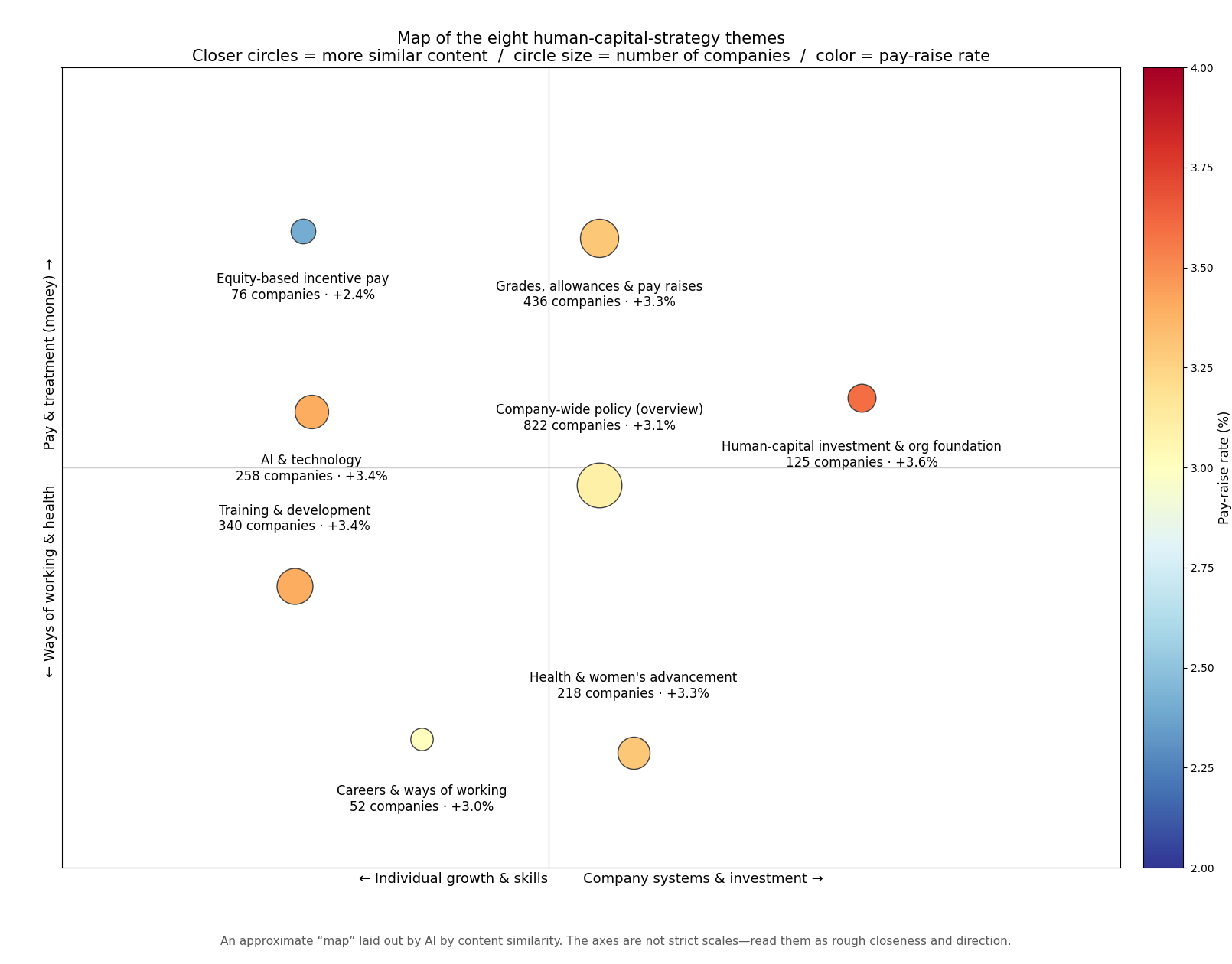
The size of each circle is “how many companies mainly write about that theme,” and the color is “the pay-raise rate of those companies.” The color, though, is the median calculated only from companies whose pay-raise rate was available as a number (companies without one are still counted in the circle size, i.e., the company count).
Roughly, the themes broke down as: (1) company-wide policy and value creation (the biggest, catch-all bucket), (2) grades, allowances, and pay-raise systems, (3) training and development, (4) AI and technology, (5) health and women’s advancement, (6) human-capital investment, (7) equity-based incentive pay, and (8) careers and ways of working.
The theme sorting covered the 2,328 companies that had human-capital-strategy text; the remaining 20 had a blank field. Because each company is assigned to a single main theme, the circle counts add up to 2,327 (just one company drops out — it had text, but no analytically useful words survived).
Different industries talk about different things
Look at which themes show up by industry, and the split is fairly sharp.
- Information and communications: overwhelmingly “AI”
- Finance (banks): “careers and ways of working”
- Construction: “health, safety, and women’s advancement”
- Services: “equity-based incentive pay”
Once you see it, it makes sense.
IT talking about AI is a given; construction talks health and safety because of on-site accident risk, and finance talks careers because of workforce mobility. Each industry’s circumstances come through.
A small discovery
Overlay the themes with pay-raise rates, and a pattern appears: the more a company talks about AI or investment, the more generous its pay raises; companies that put performance-linked or equity pay front and center tend to raise pay more modestly.
Investment-minded companies spread it around to their people too; merit-focused companies take a sharper, more selective approach. Maybe those differences in character are showing through.
But everyone looks alike
I tried various models this time, and in every case the themes didn’t separate cleanly, or the way they separated was unstable.
Probably because disclosure has only just begun — many companies write in a similar way, still lined up and watching each other.
That may be only natural for the first year of a new item, but in its own way it was an interesting finding.
I’m looking forward to seeing how each company’s character comes out in the years ahead.
Closing thoughts
Share buybacks get all the attention these days, but I hope this added disclosure raises transparency and moves us toward a virtuous cycle of investment in human capital and rising wages — that’s what I’m rooting for, as one accountant.
This article is an English adaptation of a piece originally published on note (in Japanese). The original is here (note).